
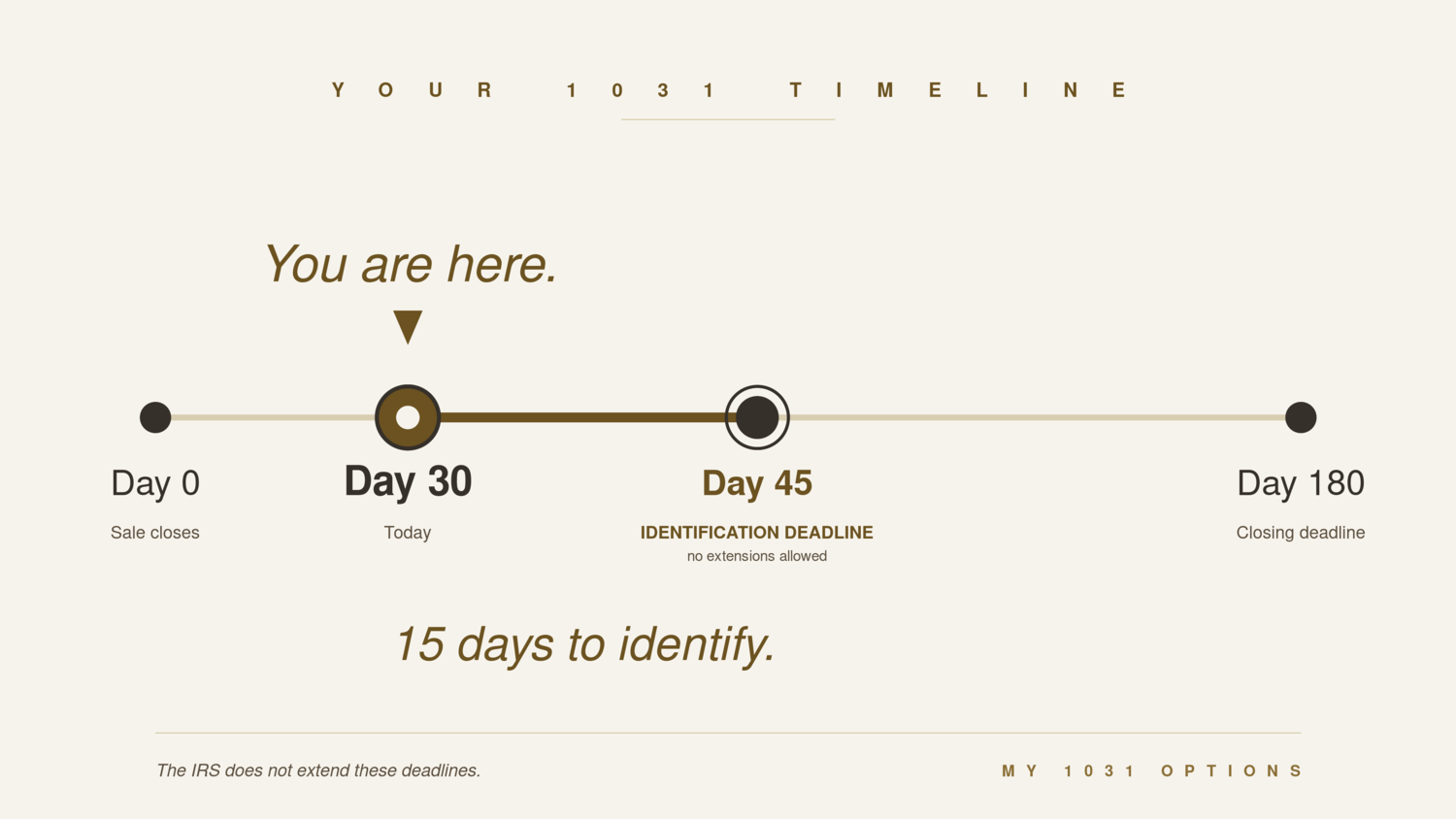
You closed on your investment property 30 days ago. You meant to identify replacement property earlier. Life got in the way. The lender on your prospective replacement pulled out, or the property went to another bidder, or the seller raised the price, or you started researching DSTs three weeks later than you should have. Either way, you have 15 days left on the IRS clock. This article is the playbook for what to do now.
The federal facts at Day 30
| Rule | What it means | When to use it |
|---|---|---|
| Three-Property Rule | Identify up to 3 properties regardless of combined value. | Direct property exchanges with one or two backups. |
| 200% Rule | Identify any number of properties as long as combined value is under 200% of relinquished sale price. | Most common for DST identification; allows multiple backup offerings. |
| 95% Rule | Identify any number of properties of any value, but must close on at least 95% of total identified. | Almost never used; the 95% threshold is unforgiving. |
You have until midnight of Day 45 to submit written identification of replacement property to your Qualified Intermediary. The IRS does not grant extensions. Not for personal hardship, not for natural disasters in most cases, not for anything short of a federally declared disaster zone in your specific location.
You must pick one of three identification rules. You cannot mix them.
The three-property rule lets you identify up to three replacement properties regardless of their combined value. Most common for direct real estate exchanges.
The 200% rule lets you identify any number of replacement properties as long as their combined fair market value does not exceed 200% of your relinquished property's sale price. This is the rule most accredited investors use when identifying DSTs as replacement.
The 95% rule lets you identify any number of replacement properties of any combined value, but you must close on at least 95% of the total identified value. Almost no one uses this rule because the 95% threshold is unforgiving and a single failed closing collapses the entire exchange.
Identification must be in writing, dated, and delivered to your QI. An email to your QI's identification address that arrives at 12:01 AM on Day 46 is a failed exchange. The clock does not care about your time zone.
Your three realistic paths at Day 30
Path 1: Direct property with a known seller. You have a property you want and an engaged seller. This is the cleanest path, but at Day 30 you are racing inspection, financing, title work, and the closing process to fit inside Day 180. Doable if everything is already in motion. Not doable if you are starting from a cold list.
Path 2: Direct property cold-search. You start looking now. At Day 30, this path has the lowest probability of success. The 15 days you have left for identification do not include the additional 135 days you would need for inspection, financing, and closing. Most direct property exchanges that start at Day 30 fail.
Path 3: DST identification. Delaware Statutory Trust offerings exist today, with current availability and current fee disclosures. The subscription process typically takes 5 to 10 business days. The sponsor closes on the underlying property; you subscribe to a beneficial interest. The structural advantage at Day 30 is real: a DST is a pre-packaged replacement property you can identify, evaluate, and subscribe to inside the time you have left.
Why DSTs become the practical path at Day 30
A direct property purchase requires you to source, negotiate, inspect, finance, and close. A DST requires you to evaluate the sponsor, evaluate the property, complete subscription paperwork, and wire the funds your QI is holding.
The 200% rule lets you identify multiple DSTs as backups. Most investors at Day 30 identify two or three offerings: one preferred, one or two alternates. If your preferred sponsor's offering fills up or has subscription issues, you can pivot to the next.
DST availability is current. There are typically 30 to 50 DST offerings open at any given time across the major sponsors. The Sponsor Evaluation Framework on this site exists to help you compare them on the same questions in less time than each individual sponsor's PPM takes to read.
What to do today
If you are at Day 30 with nothing identified, today's actions are:
Call a registered representative (FINRA/SIPC member) and have a 30-minute conversation about your situation. Tell them your relinquished property's sale price, your accreditation status, your residence state, and your replacement preferences (geography, property type, hold horizon).
Ask for three to five DST offerings to evaluate. Get the Private Placement Memorandum for each. Read the Use of Proceeds, Compensation to Sponsor, and Conflicts of Interest sections first.
Run each offering through the Sponsor Evaluation Framework on this site. The three tests (Credit Discipline, Metro Discipline, Structural Simplicity) take 20 minutes per offering once you know what to look for.
By Day 35 to Day 40, you should have a primary identification and one or two backups. Submit identification to your QI in writing by Day 44 at the latest. Day 45 is for emergencies, not for "good enough."
Common mistakes at Day 30
The mistake we see most often is investors trying to source a direct property at Day 30 because they want the deal they thought they were going to do. By Day 30 the math has changed. The 15 days you have left favor the structure that is purpose-built for short timelines.
The second mistake is identification that doesn't satisfy the IRS rules. "I'm thinking about a property in Austin" is not identification. Identification requires the property address (for direct real estate) or the specific DST offering name and sponsor (for DSTs) in writing, signed, and delivered to your QI.
The third mistake is confusing identification with subscription. By Day 45 you must have identified. By Day 180 you must have closed. For DSTs, closing means subscription paperwork accepted and funds wired by the QI. The two clocks run in parallel; the first is what you focus on at Day 30.
When the exchange genuinely cannot be saved
If you reach Day 44 and you genuinely cannot identify a replacement property you would actually buy, the exchange will fail. The full gain on your relinquished property becomes immediately taxable. The Failed 1031 Recovery guide on this site walks through the partial deferral options and the structural moves that can salvage some, but rarely all, of the deferred gain.
The right move is not to identify something you would not actually buy in order to keep the exchange technically alive. A bad DST identification followed by a forced subscription is worse than a failed exchange. The structure works only if the underlying investment is appropriate for your situation.
If you are still inside the 45-day window and reading this, the playbook above is the realistic path. Call a specialist today.
This article is educational and is not tax, legal, or investment advice. Consult your own CPA, tax attorney, and qualified financial professional before pursuing a 1031 exchange. My 1031 Options is an educational resource published by Medalist Diversified, Inc. (NASDAQ: MDRR). This is not an offer to sell or a solicitation of an offer to buy any security. Securities are offered only by means of a Private Placement Memorandum to accredited investors as defined in Rule 501 of Regulation D.
